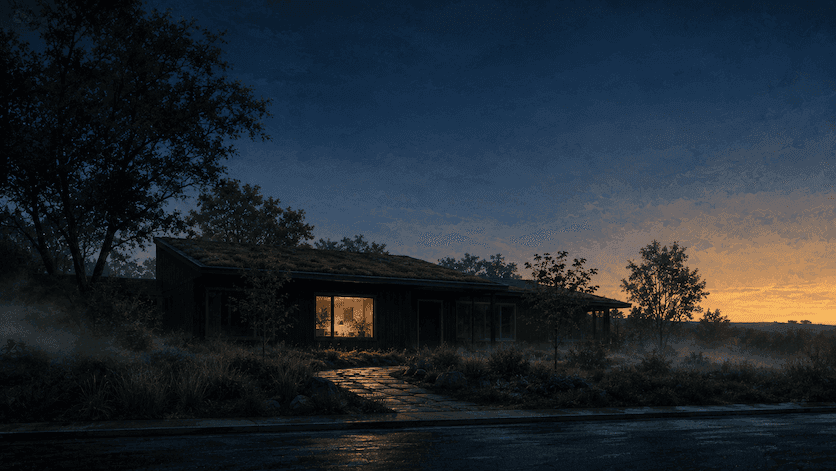
It's 6:14 a.m. on a Tuesday. Two operators at landscape companies of roughly equal size, in roughly the same region, walk into their offices at exactly the same minute.
The first opens her laptop and sees 142 unread emails. 14 of them are flagged as urgent. 3 are about properties she's never heard of. She'll spend the next two hours triaging. She'll get to actual decisions around 9.
The second opens her laptop and sees a single panel at the top of her dashboard. It reads:
Good morning. Four priorities for today. Eight tasks already drafted, waiting for your review. Twelve other things were resolved overnight without your input.
She'll start making decisions in eleven minutes.
The difference between these two operators is not their software stack. It's whether their software stack had a working overnight shift.
This post is about that overnight shift. What we call NightShift at HeyFlora, what it actually does between 9 p.m. and 6 a.m., and what an operator can reasonably expect to wake up to.
TL;DR
- Most landscape software is request-response. You ask it something, it tells you something. When you're not asking, it's not working.
- The opportunity sitting on the table is the nine hours between when the last crew clocks out and the first manager walks in.
- NightShift is HeyFlora's autonomous layer. It monitors, analyzes, drafts, alerts, and books while you sleep.
- The operator's job in the morning isn't to do the work. It's to approve the work that's already been done.
- A working overnight shift is the single biggest unlock for operator time we've seen.
What NightShift actually does between 9 p.m. and 6 a.m.
NightShift runs every night, end-to-end, in five passes.
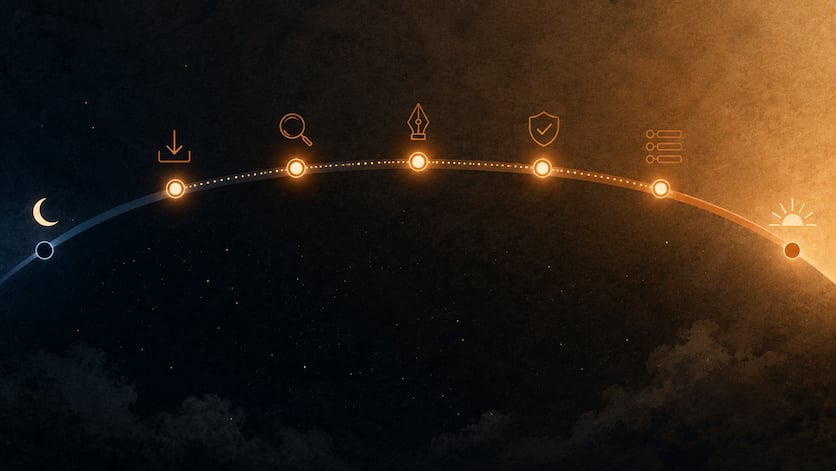
9 p.m. to 11 p.m., Ingestion. Pulls fresh data from every connected system once the team logs off. Aspire job-cost actuals for the day, Fleetio telematics, weather forecasts, ADP timecards, completed huddles and snaps from the field, email signals, and the day's new tickets. By 11 the system has a complete state of the business as of close.
11 p.m. to 2 a.m., Analysis. Cross-references everything. Properties that ran over hours and why. Routes that varied from plan. Job-cost margins that drifted. Renewal pipeline ages. Equipment hours approaching service. Customer email tone changes. Weather impacts crossing the next 72 hours of route plans. None of this is one query. It's cross-system reasoning, the kind a human ops lead would do over the course of a week and that the systems alone won't surface.
2 a.m. to 4 a.m., Drafting. Drafts proposals for enhancement opportunities flagged on the day's snaps and huddles. Drafts schedule shifts for crews trending over plan. Drafts renewal warnings for accounts with declining sentiment. Drafts service follow-ups, equipment maintenance requests, route reorganizations. Every draft goes into a queue, marked for human review. Nothing is sent yet.
4 a.m. to 5 a.m., Evaluations. Every draft gets checked against company standards. Did the proposal use the right pricing book? Does the renewal warning match the customer's actual history? Is the schedule shift respecting certifications and time-off requests? Drafts that fail are flagged for closer review instead of surfaced as ready.
5 a.m. to 6 a.m., Ranking and prep. Drafts that passed evaluation are ranked by urgency, dollarized where possible (the proposal is worth $8,400, the route fix saves 2.4 hours), and queued for the operator's morning. The single morning panel (four priorities, eight drafts, twelve resolved) gets composed.
When the first manager walks in at 6:42 a.m., the work is done. What's left is the decisions.
What NightShift actually drafts
Five categories, in roughly the order most landscape companies feel them.
Enhancement proposals. Any snap, huddle, or site walk that flagged an opportunity yesterday becomes a draft proposal overnight. The pricing book is applied. The customer's history is referenced. The bilingual version is generated. The proposal sits in the morning queue, fully drafted, waiting for a manager's "send."
This single thing tends to be the highest-dollar item NightShift delivers. The reason: most landscape companies are sitting on enhancement opportunities they walked past in the field. Their proposal-to-revenue conversion rate isn't constrained by sales. It's constrained by how many proposals actually get drafted. Drafting is a labor bottleneck. NightShift eliminates it.
Schedule shifts. Crews trending over plan, weather crossing routes, certifications expiring, equipment due for service. Any of these triggers a draft schedule shift for tomorrow. The operator wakes up to "Crews 4 to 7 trending 23% over plan, schedule shift queued for review." Not a problem to solve. A decision to approve.
Renewal warnings. Renewal pipeline isn't a calendar problem. It's a sentiment problem. Customers leave when they feel unheard, not when their contract expires. NightShift watches email tone, site-walk frequency, snap activity, and explicit signals (rate complaints, scope creep questions). Properties drifting toward churn get flagged with a draft talking-points memo for the account manager.
Heat advisories and weather pivots. Any 36-hour forecast that affects turf properties, irrigation schedules, or crew safety becomes a draft route reorganization. The operator wakes up to "Heat advisory affecting 12 turf properties, routes reordered for 11 a.m. cutoff," not a 7 a.m. scramble.
Margin and P&L flash. Yesterday's job-cost actuals against plan, dollarized to the property level. Anything off by more than 15% becomes a draft inquiry to the operations lead. The big margin slips are caught the morning after, not the month after.
The hard part: how do you trust this?
The fair question every operator asks the first time they hear about autonomous overnight work is "what if it does something wrong?"
Three things make this safe in practice.
Drafts, not sends. Nothing leaves the building on its own. Proposals are drafted but not sent. Schedule shifts are queued but not applied. Renewal warnings sit in the operator's morning queue, not the customer's inbox. The autonomous part is the work-on-your-behalf part, not the decision-on-your-behalf part. The operator is still the one shipping.
Eval gates. Every draft is checked against company standards before it surfaces. If a proposal's pricing doesn't match the pricing book, it's flagged for closer review, not surfaced as ready. (This is primitive #5 from Post 2 doing its job.)
Self-learning from corrections. When an operator edits a draft, NightShift learns. When a renewal warning is marked as a false positive, NightShift learns. The system gets calibrated to your operation over the first 60 days. By month three, the drafts read like you wrote them.
What you don't get with NightShift: an autonomous system that's going to send a customer a wrong proposal. You couldn't ship the platform with that risk.
A real-feeling Wednesday morning
What the morning panel looks like when a $42M landscape company has NightShift running. Hypothetical but representative.
Wednesday, 6:42 a.m.
4 priorities:
- Mulch installations down 31% year-over-year. 28 properties flagged. Proposals drafted for top 8.
- ABC Plaza renewal at risk. Sentiment from 6 site walks declining. Account-manager memo drafted.
- Heat advisory affecting 12 turf properties. Routes reordered for 11 a.m. cutoff.
- Crews 4 to 7 trending 23% over plan. Schedule shift queued for tomorrow.
8 drafts waiting for your review.
12 things resolved overnight without your input. View summary.
That morning panel replaces approximately three hours of typical morning triage. Not because the work didn't happen. Because it happened between 11 p.m. and 6 a.m., while the operator slept.
What you wake up to vs. what your team wakes up to
The hardest pattern to break in growing landscape companies is this: the more the business grows, the more questions land in the operator's inbox. At a certain size, the founder stops being a strategist and starts being a triage center. Every meaningful decision routes through one person. The bottleneck is the operator's morning.
NightShift moves the bottleneck. Once the morning panel becomes the standard view, the operator's job shifts from "find what needs doing" to "decide what to ship." The decisions take eleven minutes instead of three hours. The rest of the day is available for the work only the operator can do.
This is also what makes NightShift survivable as the company grows. A $20M operation has one ops lead and one founder doing morning triage. A $200M operation has six. Six ops leads each doing three hours of morning triage is 18 hours of senior labor per day, gone, before any actual work happens. NightShift recovers it.
The math, roughly
The conservative estimate, based on how the operators we work with describe their pre-NightShift mornings:
- 90 to 180 minutes per operator per workday, reclaimed
- 22 workdays per month, so 33 to 66 hours of operator time saved per person per month
- At $80 to $120 fully-loaded cost per ops-lead-hour, $2,640 to $7,920 per operator per month
A landscape company with six operators saves $15K to $47K per month in operator labor alone. That doesn't count the proposals that got drafted that wouldn't have, the renewals that got saved, the heat-advisory routes that didn't blow up.
The math isn't subtle. It's just that the cost is invisible until something replaces it.
What's coming
The first three Field Notes in this series have walked through the architecture in three layers: the connection problem (the layer underneath), the six primitives (the architecture inside), and now NightShift (the outcome on top). The next posts will get specific: how to think about the GroundSkills marketplace, what bilingual operations actually requires, what a properly evaluated AI workflow looks like end-to-end.
For now: if your operators are starting their morning by triaging, the leverage isn't a faster triage tool. It's a working overnight shift.
Scott Hutcheon is the founder and CEO of HeyFlora. He's spent twenty-five years in design-build, green infrastructure, and landscape technology. HeyFlora is building Artificial Grounds Intelligence, the AI operating system for commercial landscape.
Read Post 1: The connection problem and Post 2: Six primitives behind autonomous execution. Or get the next Field Note in your inbox: Subscribe to Grounds Intelligence Weekly.